 info@millenniumsemi.com
 Sales: +91 8411005847




In electronics manufacturing, outcomes don’t usually fail because of weak ideas or lack of intent. They fail quietly — in the spaces between design, sourcing, execution, and delivery.
A design looks perfect but struggles to scale. A component works in prototype but becomes unavailable in production. A BOM is approved, yet production lines wait for parts. Logistics works — until it doesn’t.
For Indian electronics manufacturers — OEMs, EMS players, and product companies — this is not an occasional disruption. It is the reality of building in a fast-moving, globally connected ecosystem.
As India accelerates its ambition to become a global electronics manufacturing hub, the conversation often centers on capacity, incentives, and localization. But on the ground, a more practical question decides success or failure:
What actually changes outcomes — from design to delivery?
The answer is increasingly clear:
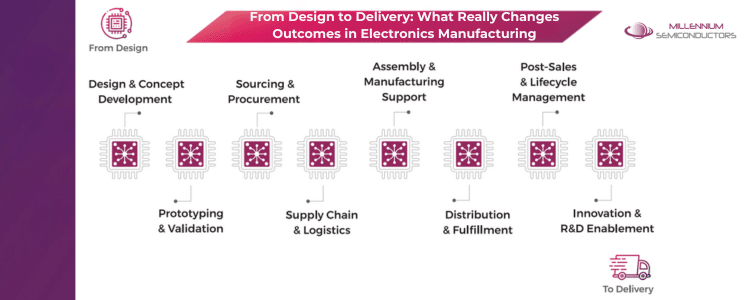
Outcomes change when the electronics ecosystem is enabled at every step.
Scale That Grounds the Perspective
This understanding doesn’t come from theory. It comes from scale, continuity, and depth.
With over 30 years in the electronics ecosystem, 500+ years of combined expertise, partnerships as an authorised distributor for 120+ global manufacturers, and a base of 5,000+ customers, Millennium operates across more than 12 industry segments — including automotive, consumer electronics, industrial, lighting, and emerging domains such as power, IoT, and data centres.
This scale is supported by a robust geographic presence across India, along with operations in China and ASEAN, allowing close proximity to customers while remaining connected to regional and global supply chains.
But scale, by itself, does not change outcomes. What matters is how that scale is applied across the journey from design to delivery.
Design: Where Most Outcomes Are Already Decided
Industry research consistently shows that early design decisions determine a majority of downstream cost, reliability, and scalability outcomes. IPC and McKinsey both highlight that design choices around component selection and validation are among the most common sources of late-stage rework and delays.
Yet design is often treated as an isolated engineering activity.
Millennium approaches design as an ecosystem function. A strong AE and FAE team, supported by 100+ reference solutions, enables manufacturers to make design decisions informed by real-world availability, lifecycle visibility, and application-level performance — not assumptions.
Design intelligence, early validation, and system-level thinking help bridge the gap between engineering intent and manufacturing reality.
What changes: Design freezes happen faster. Alternates are built in early. Rework reduces dramatically.
Sourcing: From Procurement to Strategy
As products move closer to production, sourcing becomes the next critical fault line.
PwC and Deloitte both point out that supply-chain volatility and component lifecycle risks remain major constraints for electronics manufacturers, even as demand grows.
Here, sourcing must move beyond transactional procurement.
Millennium’s role as an authorised distributor for 120+ global manufacturers allows sourcing to be aligned with design intent, lifecycle planning, and future scalability. Component selection, alternates, and continuity planning are approached as part of a broader execution strategy.
What changes: Sourcing becomes predictable instead of reactive. Supply risk is managed earlier, not escalated later.
Kitting & Consolidation: A Capability That Changes Outcomes When Needed
Kitting becomes critical when production moves beyond prototypes — when multiple SKUs, frequent changeovers, and tight schedules start testing execution.
As manufacturers move from pilot builds to multi-line or high-mix production, managing large and dynamic E-BOMs across multiple suppliers often becomes a bottleneck.
Millennium’s kitting capability is designed to be applied selectively, where it adds the most value — managing complex E-BOMs, synchronising components across suppliers, and delivering line-ready, JIT kits aligned to production schedules.
This is not logistics by another name. It is a focused execution discipline built to support scale when scale is needed.
What changes: Production lines run smoother. Ramp-ups accelerate. Manufacturing teams focus on output, not material coordination.
Supply Chain & Logistics: The Infrastructure That Sustains Momentum
Behind execution excellence lies infrastructure.
Millennium operates one of the largest ESD-certified warehousing infrastructures in the Indian electronics distribution ecosystem, anchored by a 100,000 sq. ft. facility in Chakan, supported by warehouses in Noida, Singapore, and China.
As Gartner has consistently highlighted, integrated, visibility-driven supply chains are becoming a key differentiator for manufacturing competitiveness — especially in electronics. In line with this, Millennium’s supply-chain systems enable real-time visibility across sourcing, warehousing, and dispatch, while capabilities such as imports management, customs clearance, DOL execution, stocking, and JIT deliveries ensure continuity across production cycles and geographies.
What changes: Timelines become predictable. Supply interruptions reduce. Scaling feels controlled, not chaotic.
Testing, Validation & Digitalization: Reducing Friction, Not Adding Gates
Testing and validation are often seen as late-stage hurdles. In reality, when integrated early, they reduce risk and accelerate market access.
Millennium’s testing and validation capabilities are complemented by a strong focus on digitalization — including automation, AI-enabled platforms, and customer and vendor portals that improve visibility, responsiveness, and coordination across the ecosystem.
Rather than adding layers, these digital tools remove friction — allowing information, decisions, and materials to move faster and more reliably across design, sourcing, and delivery.
What changes: Faster certifications. Fewer surprises. Shorter paths to market.
Enabling the Electronics Ecosystem — At Every Step
What ultimately changes outcomes is not excellence at one stage, but continuity across all stages.
When design intelligence flows into sourcing, when sourcing aligns with execution choices, when optional capabilities like kitting are deployed where they add the most value, and when supply chains are digitally enabled and reliable —
the electronics ecosystem starts working as a system.
This is the philosophy behind Millennium’s approach: Enabling the Electronics Ecosystem — from design to delivery.
Rooted deeply in India’s manufacturing landscape and increasingly connected across ASEAN and global supply chains, Millennium enables electronic makers to move faster, scale smarter, and execute with confidence.
Because in electronics manufacturing, outcomes don’t improve by chance. They improve when the ecosystem is enabled — deliberately, end to end.