
 info@millenniumsemi.com
 Sales: +91 8411005847




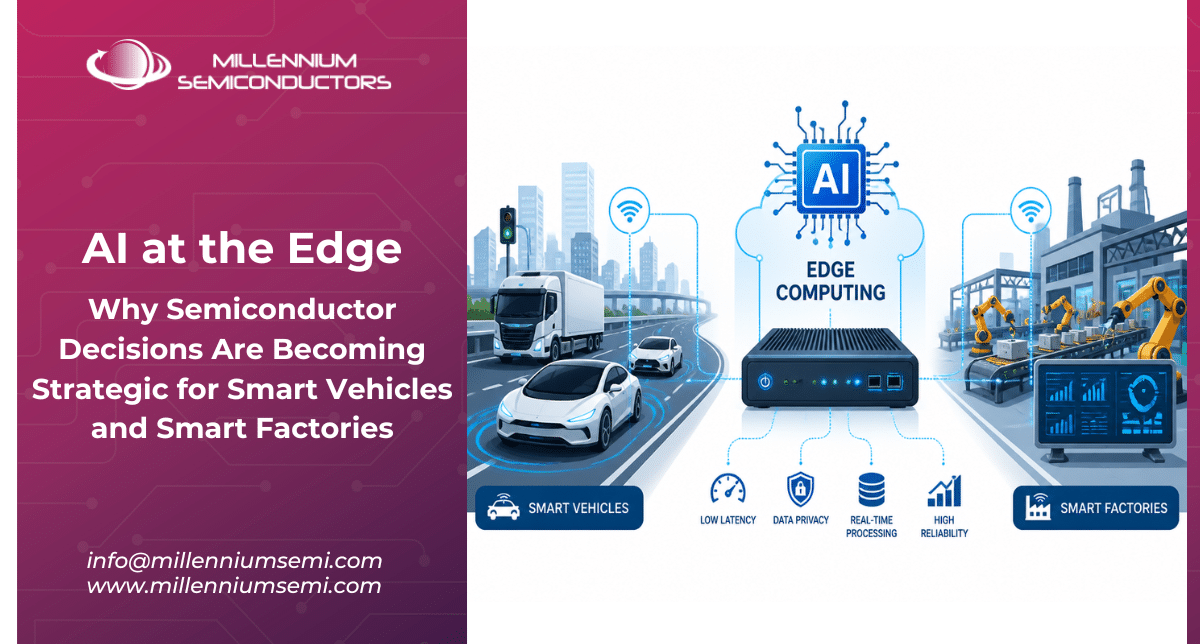
Key Takeaways
- Edge AI is rapidly moving intelligence from centralized cloud environments into vehicles, factories, industrial equipment, and other physical systems where decisions must happen in real time.
- The shift is being driven by practical requirements such as latency, reliability, safety, bandwidth efficiency, and operational autonomy rather than by AI adoption alone.
- As AI workloads move closer to the point of action, semiconductor requirements are changing significantly, creating new demands across compute, memory, sensing, connectivity, power management, and security technologies.
- Despite serving different applications, smart vehicles and smart factories increasingly rely on a remarkably similar semiconductor foundation.
- Semiconductor selection is evolving from a component-level decision into a strategic business decision that directly impacts product performance, scalability, lifecycle continuity, and time-to-market.
- As Edge AI systems become more complex, OEMs need ecosystem partners who can help bridge technology selection, engineering support, supply continuity, and execution readiness.
AI Is Moving Into the Physical World
Over the last decade, the AI conversation has largely been centered around the cloud. Organizations invested in cloud infrastructure, trained increasingly sophisticated models, and built applications that relied on centralized computing resources. The cloud became the engine powering AI innovation.
That model is now evolving. The next phase of AI growth is not defined by where models are trained. It is defined by where decisions are made.
Increasingly, those decisions are happening inside vehicles, on factory floors, within industrial equipment, and across connected infrastructure systems.
A vehicle navigating a busy urban road cannot wait for a cloud response before applying brakes. A robotic arm performing high-precision assembly cannot afford network latency during a critical movement. A machine vision system inspecting thousands of products per hour generates more data than can be economically transmitted and processed remotely.
In each of these situations, intelligence must exist where the action takes place.
This is the fundamental idea behind Edge AI.
According to Fortune Business Insights, the global Edge AI market is projected to grow from approximately $47.6 billion in 2026 to nearly $386 billion by 2034, reflecting the growing demand for real-time intelligence across industries. The scale of this growth indicates that Edge AI is no longer an emerging technology trend. It is becoming a foundational technology strategy for next-generation products and systems.
For OEMs, this shift is particularly significant.
Whether developing electric vehicles, industrial automation systems, intelligent energy infrastructure, robotics platforms, or connected products, the ability to process information locally is becoming a competitive requirement rather than a technological differentiator.
The question is no longer whether AI will be deployed at the edge. The question is how effectively organizations can design systems capable of supporting it.
Why Cloud AI Alone Is No Longer Enough
The cloud remains essential to AI development. Large-scale model training, data aggregation, analytics, and orchestration will continue to rely heavily on cloud infrastructure.
However, the physical world operates under constraints that cloud architectures alone cannot solve. Latency is the most obvious example.
An advanced driver assistance system may need to make decisions within milliseconds. Industrial safety systems often require immediate responses to prevent equipment damage or operator injury. In these environments, delays that are acceptable in consumer applications become unacceptable.
Bandwidth presents another challenge.
Modern vehicles generate enormous amounts of sensor data through cameras, radar systems, LiDAR, ultrasonic sensors, and vehicle telemetry. Similarly, factories increasingly rely on machine vision, industrial sensors, robotics, and predictive maintenance systems that continuously generate data streams.
Transmitting every piece of data to the cloud for processing is often impractical, expensive, and inefficient. There is also the question of reliability.
A smart factory cannot pause production because of a temporary network interruption. A vehicle cannot lose critical functionality because cloud connectivity is unavailable. As systems become increasingly autonomous, local intelligence becomes essential to maintaining operational continuity.
SEMI recently highlighted how Edge AI is becoming increasingly important in semiconductor manufacturing environments themselves, where intelligent systems are being used to improve operational efficiency, predictive maintenance, process optimization, and resilience. The same principles are now being applied across automotive and industrial sectors.
For OEMs, the implication is clear.
The future architecture of intelligent products will increasingly require a combination of cloud intelligence and edge intelligence working together. And that architectural shift has significant consequences for semiconductor design.
What OEMs Must Consider When Designing the Next Generation of Edge AI Systems
For engineering teams, product architects, and technology leaders, Edge AI introduces a new set of design priorities.
Historically, embedded systems were designed primarily around sensing, control, communication, and power efficiency.
Edge AI systems introduce an additional requirement: intelligence.
That seemingly simple addition creates substantial architectural implications.
Products must now process larger volumes of data locally. They must support increasingly sophisticated algorithms while maintaining power efficiency. They must deliver real-time performance without compromising safety, reliability, or cybersecurity.
As a result, OEMs are increasingly evaluating design decisions through a broader lens.
Performance remains important. But so do scalability, software compatibility, lifecycle continuity, and future upgradeability.
In automotive applications, these requirements are driving the transition toward software-defined vehicle architectures, where intelligence becomes a core feature of the vehicle rather than an isolated function.
In industrial environments, similar forces are driving investment in autonomous robotics, machine vision, predictive maintenance, and adaptive manufacturing systems.
Although the applications may differ, the underlying challenge remains remarkably similar:
How do you build systems capable of sensing, understanding, deciding, and acting in real time?
The answer increasingly depends on the semiconductor foundation beneath them.
Different Applications. One Semiconductor Foundation.
At first glance, a software-defined vehicle and a smart factory appear to have little in common.
One transports people and goods. The other manufactures products.
Yet when viewed through the lens of Edge AI, they begin to look remarkably similar.
Both environments rely on continuous sensing, local decision-making, high-speed communication, and autonomous action. Both require systems capable of processing vast amounts of data in real time. Both operate in environments where reliability, safety, and uptime are critical.
As a result, the semiconductor technologies enabling them are increasingly converging.
Compute: Where Intelligence Happens
At the heart of every Edge AI system lies compute capability.
Whether it is a vehicle interpreting data from multiple sensors or an industrial robot adjusting its movement based on changing conditions, local intelligence requires significant processing power.
The technologies supporting this include:
- AI Accelerators and Neural Processing Units (NPUs)
- High-performance Microprocessors (MPUs)
- Real-time Microcontrollers (MCUs)
- System-on-Chip (SoC) platforms
According to McKinsey’s automotive electronics research, the increasing adoption of AI-enabled functions is driving a major transformation in vehicle electronic architectures, requiring substantially greater computing capability than previous generations.
The same trend is visible across industrial automation, where machine vision, robotics, and predictive maintenance applications increasingly rely on edge processing rather than centralized systems.
Memory: The Often-Overlooked Enabler
Intelligence without memory is impossible. As AI models become larger and more sophisticated, memory architectures are becoming increasingly important.
Modern Edge AI platforms depend on:
- DDR memory
- NAND Flash
- NOR Flash
- Embedded memory technologies
These components determine how quickly systems can access, process, and store information.
For OEMs, memory decisions increasingly influence system responsiveness, scalability, and future software upgrade capabilities.
Sensors: The Eyes and Ears of Edge AI
An AI system is only as effective as the data it receives.
This makes sensing technologies one of the most critical layers within the Edge AI stack.
Across automotive and industrial applications, key technologies include:
- Image sensors
- Radar technologies
- LiDAR systems
- Position sensors
- Environmental sensors
- Motion sensing technologies
In a vehicle, these technologies enable functions such as driver assistance, obstacle detection, and autonomous navigation.
In factories, they support machine vision, quality inspection, asset monitoring, worker safety, and robotics.
The applications differ. The semiconductor foundation remains strikingly similar.
Connectivity: Connecting Intelligence Across Systems
Edge AI does not eliminate connectivity. It changes its role.
Instead of continuously transmitting data for centralized processing, connected systems increasingly exchange intelligence, decisions, and insights.
Technologies enabling this include:
- Automotive Ethernet
- Industrial Ethernet
- CAN and CAN-FD
- Bluetooth Low Energy
- Wi-Fi
- Cellular IoT technologies
The growing importance of connected intelligence is driving demand for robust, secure, and low-latency communication architectures.
Power Management: The Foundation of Efficient Edge Intelligence
Perhaps one of the most significant shifts occurring within Edge AI systems is power consumption.
More intelligence requires more processing.
More processing creates greater power and thermal demands.
This is driving growing adoption of:
- Power Management ICs (PMICs)
- DC-DC converters
- Battery management technologies
- Power MOSFETs
- Silicon Carbide (SiC) devices
- Gallium Nitride (GaN) technologies
As OEMs push for higher performance within constrained power budgets, efficient power management is becoming a key design differentiator.
Security: Protecting Intelligent Systems
As vehicles and industrial systems become more connected and autonomous, security is moving from an optional feature to a foundational requirement.
Edge AI systems increasingly depend on:
- Secure Elements
- Authentication ICs
- Hardware security modules
- Trusted execution technologies
These technologies help protect intellectual property, ensure system integrity, and reduce cybersecurity risks.
For OEMs, security is no longer simply a compliance requirement. It is increasingly a product requirement.
Why Semiconductor Decisions Are Becoming Strategic Decisions
Historically, semiconductor selection was often viewed as an engineering activity.
The primary considerations were performance, cost, and availability.
That equation is changing.
In Edge AI systems, semiconductor choices increasingly influence:
- AI performance
- Power efficiency
- Functional safety
- Cybersecurity
- Product scalability
- Software flexibility
- Lifecycle continuity
- Time-to-market
A processor decision can affect future software capabilities. A memory architecture decision can influence upgrade paths.
A connectivity choice can impact interoperability across the product lifecycle. A power management strategy can determine whether a product achieves performance objectives within thermal constraints.
In other words, semiconductor selection is increasingly becoming an architectural decision rather than a component decision. And architectural decisions have business consequences.
For OEMs investing in next-generation products, the quality of semiconductor decisions increasingly influences competitive positioning.
The New Challenge: Managing Complexity Across the Stack
While Edge AI creates exciting opportunities, it also introduces new challenges.
The challenge is no longer identifying an AI processor or selecting a sensor.
The challenge is integrating multiple technology layers into a coherent, scalable, and supportable system.
OEMs today must navigate:
- hardware-software integration
- functional safety requirements
- cybersecurity expectations
- validation complexity
- lifecycle management
- sourcing continuity
- technology evolution
Many organizations discover that individual components perform well independently but integrating them into a robust production-ready system requires significantly greater effort.
This is particularly true as product development cycles shorten while technology complexity continues to increase.
The challenge facing engineering teams is therefore becoming less about individual technologies and more about ecosystem orchestration.
From Semiconductor Access to Ecosystem Enablement
This is where the conversation moves beyond components.
As Edge AI systems become more sophisticated, OEMs increasingly require access not only to semiconductor technologies but also to the expertise and ecosystem support surrounding them.
The most successful programs are rarely built around a single component.
They are built around technology ecosystems that bring together compute, memory, sensing, connectivity, power management, security, software, and lifecycle support.
This is where Millennium Semiconductors plays an important role within the electronics ecosystem.
By working closely with leading global semiconductor manufacturers and supporting customers across diverse industries, Millennium helps bridge the gap between technology availability and successful implementation.
For OEMs building Edge AI-enabled products, this can include:
- access to global technology roadmaps
- engineering and application support
- guidance on semiconductor selection
- support for evolving architectures
- lifecycle visibility
- supply continuity planning
As Edge AI systems continue to evolve, these capabilities become increasingly valuable.
Because success is no longer determined by access to a single component.
It is determined by how effectively the entire semiconductor ecosystem comes together.
Strategic Takeaways
The rise of Edge AI represents one of the most significant shifts currently reshaping electronics design.
For OEMs, the implications extend far beyond software and algorithms.
Edge AI is driving new requirements across compute, memory, sensing, connectivity, power management, and security. It is influencing product architectures, engineering priorities, and technology roadmaps across automotive and industrial markets.
Perhaps most importantly, it is changing the nature of semiconductor decision-making itself.
What was once a component selection exercise is increasingly becoming a strategic business decision.
The organizations that recognize this shift early will be better positioned to build intelligent, scalable, and future-ready products.
Because in the era of Edge AI, competitive advantage will not be determined solely by how much intelligence a system contains.
It will be determined by the semiconductor foundation that enables that intelligence to perform reliably in the real world.