 info@millenniumsemi.com
 Sales: +91 9028012916




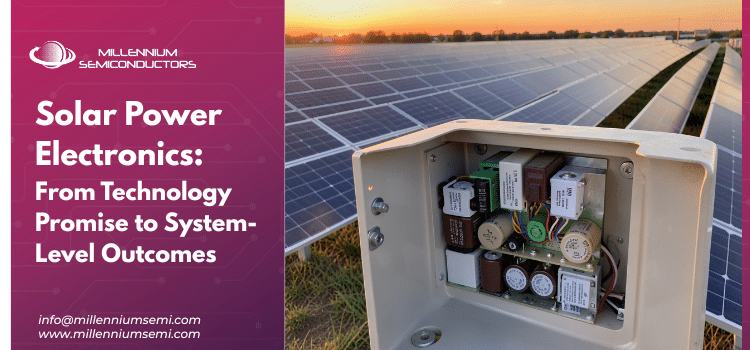
Solar power is often spoken about in terms of capacity additions, module efficiency, and cost per watt.
But on the ground, outcomes are shaped elsewhere.
They are shaped by how reliably power is converted, how intelligently it is controlled, how seamlessly it integrates with storage, how well systems are monitored, and how effectively designs translate into field-ready deployments.
As solar scales across utilities, industry, agriculture, and distributed applications, it has become clear that solar power is no longer a generation problem. It is an electronics system challenge.
Global perspectives reinforce this shift. McKinsey highlights that battery energy storage deployments are accelerating rapidly, making solar-plus-storage a default architecture rather than an exception. BCG points out that value in modern energy systems is increasingly unlocked through digital coordination of generation, storage, loads, and grid interaction.
Together, these insights point to one conclusion:
the future of solar will be decided by how well the electronics ecosystem is enabled end to end.
Solar Power Is Now an Electronics-Intensive System
In its early phase, solar systems were relatively simple. Panels generated DC power, inverters converted it to AC, and the job was largely done.
That is no longer the case.
Modern solar systems must handle variable generation, fluctuating loads, grid interaction, safety requirements, remote operation, and long-term reliability. They increasingly combine power conversion, energy storage, digital monitoring, and application-specific control into a single, coordinated architecture.
This transformation places power electronics at the centre of solar outcomes. Not as individual components, but as interconnected functional blocks that must work together reliably over years of operation.
At Millennium, this shift is fundamental to how solar is approached. Solar is not viewed as a collection of parts, but as a system-level electronics stack that must be designed, validated, executed, and supported as one.
The Solar Power Electronics Stack, Clearly and Practically Defined
To understand where projects succeed or struggle, it helps to break solar power electronics into five interconnected layers.
1. Power Conversion and Control
This layer includes inverters and MPPT-based power control. It determines how efficiently solar energy is harvested, converted, and delivered to loads or the grid.
In practice, this layer involves far more than DC-to-AC conversion. It includes sensing, protection, communication, thermal management, and control logic that must perform reliably under wide environmental and operating conditions.
Many system challenges originate here. Designs that look good on paper can struggle at scale if component choices, protection strategies, or control architectures are not aligned with real-world conditions.
Millennium works at this layer with a system view. By supporting inverter and power control designs at the block level, and by enabling access to proven technologies and design insight, Millennium helps customers move from concept designs to scalable, field-ready architectures.
This is where design intelligence directly influences execution outcomes.
2. Energy Storage and System Flexibility
Energy storage has moved from being optional to foundational.
McKinsey’s outlook makes it clear that storage is essential for integrating higher shares of solar into energy systems. But storage also introduces complexity. Battery systems demand precise charge and discharge control, safety mechanisms, thermal management, and seamless coordination with power conversion stages.
The challenge for many projects is not selecting a battery but integrating storage into the system in a way that supports reliability, lifecycle performance, and operational flexibility.
Millennium’s role in this layer is to enable storage-ready system design. By working across storage electronics, power stages, sensing, and control interfaces, Millennium helps ensure that solar-plus-storage systems behave as unified systems rather than loosely connected subsystems.
This system-level alignment is what turns storage from a risk factor into a performance enabler.
3. Monitoring, Control, and Digital Intelligence
As solar assets scale, visibility becomes critical.
Remote Monitoring Systems are no longer about basic fault alerts. They are about understanding performance trends, identifying early signs of failure, optimising energy flows, and supporting predictive maintenance.
BCG’s work on Energy Management Systems reinforces that digital orchestration is where future value lies. RMS is the foundation on which this orchestration is built.
From an electronics perspective, this layer involves controllers, power regulation, communication modules, protection, and data interfaces. Poor design choices here can limit scalability and long-term system intelligence.
Millennium supports this layer by enabling monitoring architectures that are robust, scalable, and integration-ready. The focus is not just on connectivity, but on ensuring that monitoring systems are designed to support operational decision-making over the system’s lifetime.
4. Application-Specific Solar Electronics
Solar is increasingly deployed in application-specific contexts such as irrigation, water management, and distributed energy systems.
These applications impose unique electrical and operational demands. Motor control behaviour, load variability, environmental exposure, and duty cycles differ significantly from grid-tied generation.
Pump controllers and similar application-specific electronics bridge the gap between generic solar systems and real-world use cases. They embed domain logic into control architectures, ensuring reliable operation under variable conditions.
Millennium’s work in this space reflects a broader philosophy: use cases shape electronics requirements. Supporting application-specific solar systems requires deep understanding of both power electronics and the end application, not just component availability.
5. System Enablement and Execution Readiness
As solar systems move from prototypes to scale, execution becomes decisive.
Design decisions must translate into reliable builds. Testing and validation must be aligned with real-world operating conditions. Supply and delivery must be coordinated to avoid delays and rework.
This layer is often underestimated, yet it determines whether systems scale smoothly or struggle under complexity.
Millennium’s strength lies in combining technology access with execution capability. Design support, validation readiness, coordinated supply, and deployment support come together to enable customers to move faster with confidence.
This is the practical expression of Enabling the Electronics Ecosystem.
Where Solar Projects Commonly Break Down
Across projects and applications, certain patterns repeat.
Early design decisions are made without full visibility into lifecycle, availability, or integration complexity. Testing is compressed into late stages, increasing risk. Execution struggles emerge as systems grow more complex and timelines tighten.
These failures are rarely due to lack of technology. They occur because the electronics ecosystem is not enabled as a system.
Millennium addresses this by working across layers, not in silos. The goal is not to optimise individual components, but to align design, control, monitoring, and execution into a coherent whole.
How Millennium Enables the Solar Electronics Ecosystem
Across the solar power electronics stack, Millennium works on:
- Power conversion and control systems
- MPPT-based optimisation and charging
- Battery energy storage systems
- Remote monitoring and control architectures
- Application-specific controllers for diverse solar use cases
Beyond technology coverage, Millennium brings design insight, technical depth, and execution capability. Carrying leading global technology lines, supporting block-level design, and enabling reliable execution allows Millennium to act as a true ecosystem partner.
This approach aligns closely with what global consulting insights point toward. Solar systems that succeed in the next decade will be those that are integrated, intelligent, and execution-ready.
The Strategic Takeaway
Solar power’s next phase will not be defined by panels alone.
It will be defined by how well the electronics ecosystem is enabled across conversion, storage, control, monitoring, and execution. It will reward those who think in systems, design for real-world conditions, and execute with discipline.
That is the shift shaping solar power electronics today.
And that is where Millennium positions itself — Enabling the Electronics Ecosystem to turn technology promise into system-level outcomes.